
Durability
Do steel frames rust? What protects a TRUECORE® frame, and where the limits are
By Lockyer Sheds, Crowley Vale QLD ·Comparing options · 6 min read · Published
Short answer
Steel frames can corrode, but a TRUECORE® frame starts with an AM150 aluminium, zinc and magnesium alloy coating and is designed to sit inside the building envelope, dry and separated from the weather. Corrosion risk rises near breaking surf and where frames are left exposed or poorly stored. BlueScope excludes sites within 300 m of surf from its frame warranty. Lockyer Sheds supplies frames made from TRUECORE® steel for sites across South East and Southern Queensland.
The short answer
Any steel will corrode if water and oxygen reach bare metal for long enough. A light gauge frame is not bare metal. The coil we roll-form is TRUECORE® steel, which BlueScope supplies with a metallic coating of aluminium, zinc and magnesium at coating class AM150. That coating, plus a building design that keeps the frame inside a dry, lined envelope, is what gives a steel frame its working life.
So the honest answer is: a correctly specified and correctly built steel frame in a normal Queensland inland or suburban setting is well protected. The risk goes up in three situations: very close to breaking surf, where the frame is exposed to the weather rather than enclosed, and where frame steel sits wet on site for a long time before it is built in.
What the coating on TRUECORE® steel is
BlueScope's data sheet describes TRUECORE® steel G550 as a hot-dipped, aluminium/zinc/magnesium alloy-coated structural steel with a guaranteed minimum yield strength of 550 MPa, made to AS 1397:2021. Its normal supply coating class is AM150. You will sometimes see AZ150 quoted for framing steel. That is a different coating class and it is not what the current TRUECORE® data sheet lists.
BlueScope also marks the steel with the relevant Standard, strength grade, base metal thickness, coating class and a unique identifier, so the material in a frame can be traced back to its source. Test certificates can be requested through BlueScope.
Note:Earlier editions of the NCC set a minimum coating class for steel frames inside the building envelope. That clause is not in the NCC 2022 Housing Provisions. Light gauge frames are now designed to the NASH Standard or AS/NZS 4600, which deal with durability within the design. We do not describe the old NCC 2016 rule as a current requirement.
Building near the coast
Distance from breaking surf is the single biggest site factor. The NCC defines breaking surf as salt water where waves break on average at least four days a week. Choppy water and white caps do not count, and sheltered water such as bays and rivers usually does not produce breaking surf.
BlueScope does not provide a TRUECORE® frame warranty within 300 m of surf or exposed marine influences. It says warranties may be available in calm marine settings more than 5 m from the high-water mark, such as canal estates and estuaries. If your lot is close to an ocean beach, raise it when you send plans so the question is settled before anything is manufactured.
Most of our core service area, the Darling Downs, Lockyer Valley, Somerset and the Western and Southern Downs, is a long way from any surf. Coastal SEQ sites need the address checked case by case.
| Rule or guidance | Applies to | Source |
|---|---|---|
| No TRUECORE® frame warranty within 300 m of surf or exposed marine influences | TRUECORE® steel frames (BlueScope warranty) | BlueScope warranty information |
| Definition of 'breaking surf' | Any NCC clause that measures distance from surf | NCC 2022 definitions |
| Corrosion environment bands by distance from breaking surf (Table 6.3.9a) | Hot-rolled structural steel members such as lintels, beams and posts, not light gauge frames | NCC 2022 Housing Provisions Part 6.3 |
The last row matters because it is often misapplied. Table 6.3.9a in the Housing Provisions sets corrosion environments for structural steel members, the hot-rolled beams, lintels and posts that can be supplied alongside a light gauge frame. It is not the durability rule for the roll-formed studs, plates and truss chords themselves.
Details that decide whether a frame stays dry
BlueScope's sample frame warranty is a useful checklist even if you never apply for the warranty, because it spells out the conditions that keep a frame in a benign environment. The sample conditions include:
- Frames separated from the external environment and from ground moisture.
- Homes with unlined eaves excluded.
- Steel in the subfloor space under a suspended floor excluded.
- On slab-on-ground homes, an impermeable barrier under the perimeter bottom plates.
- Plates, studs, noggings, truss chords and webs all in TRUECORE® steel.
- Fasteners suitable for ISO 9223 corrosivity category 3.
- No paint applied to the frame after manufacture, which voids the warranty.
These are the terms in a sample document. The terms that apply to a particular house are the ones on its warranty certificate, so check with BlueScope rather than relying on this list.
Storing frames on site
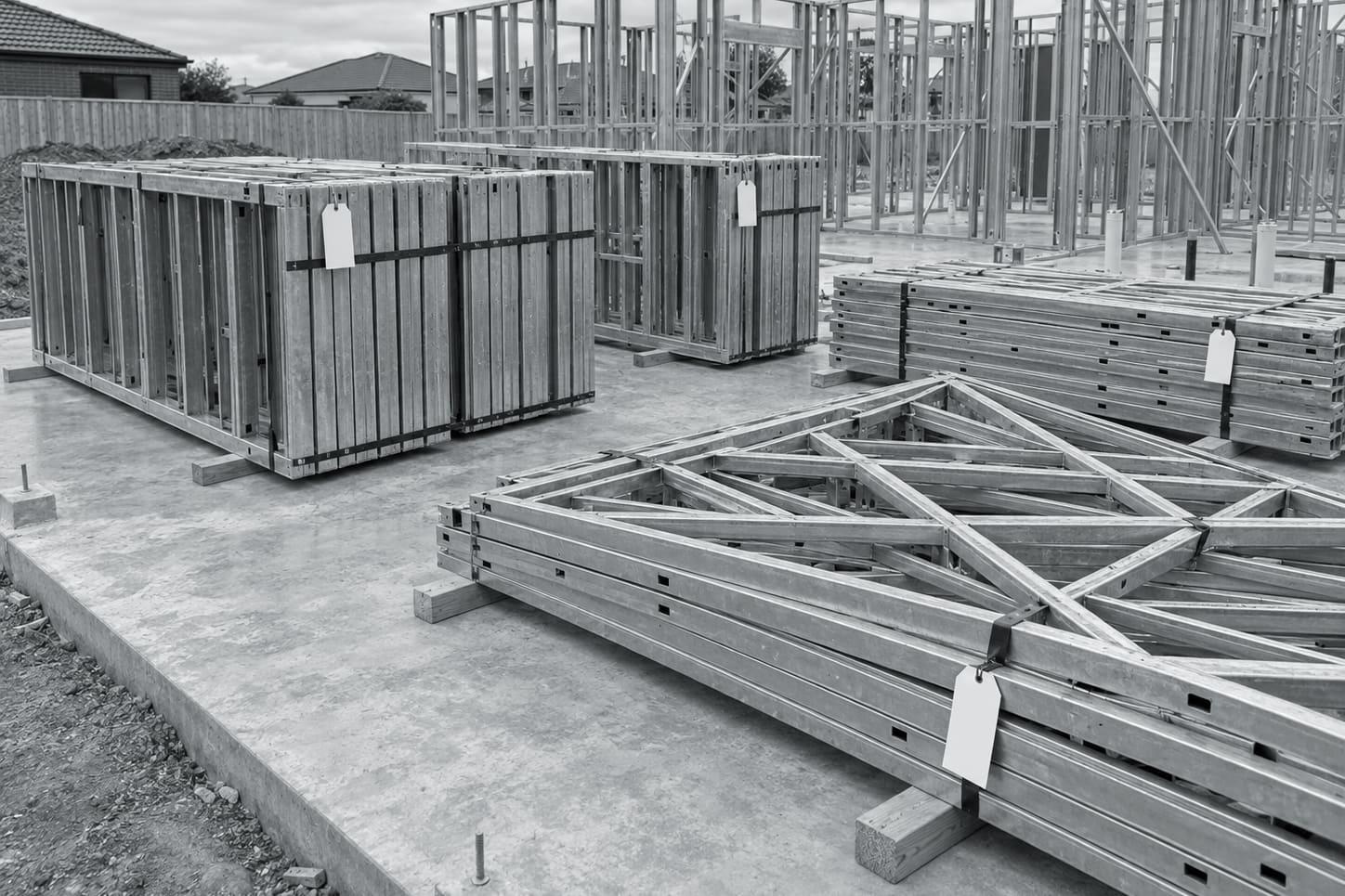
BlueScope advises that the steel be used promptly, within six months, to avoid storage-related corrosion. That advice is about coil and sheet, but the principle carries to delivered frames. Wet steel packed tightly together dries slowly.
Our practical recommendations for a delivered kit:
- Book delivery for when the slab or floor is ready, rather than weeks ahead.
- Keep bundles off the ground on bearers, on a spot that drains.
- If rain is expected, cover bundles but leave airflow so condensation can escape.
- Stand and enclose the frame in a reasonable time. A frame is designed to live inside a lined building, not in the open.
Frames that will not be enclosed
Verandah posts, open carports, unlined eaves and subfloor framing sit outside the dry envelope. These are the areas the sample warranty excludes, and they need their own specification. That can mean different members, a different protective system or a different material. Tell us about any exposed framing when you request a quote, and it will be dealt with in the design rather than discovered on site.
What to send us
Send your plans and the site address. The address lets us check the distance to surf and the wind classification together. If the site is close to the coast, we will tell you before manufacture what that means for the frame and for BlueScope's warranty eligibility.
Sources
- BlueScope – TRUECORE® steel G550 data sheet
- TRUECORE® steel – Warranty information for builders (BlueScope)
- BlueScope – TRUECORE® steel building frame sample warranty
- NCC 2022 Volume Two, Definitions (ABCB)
- NCC 2022 Housing Provisions, Part 6.3 Structural steel members (ABCB)
- Australian Steel Institute – Durability for light gauge low-rise steel framing