Materials
COLORBOND® or ZINCALUME® steel for a shed?
By Lockyer Sheds, Crowley Vale QLD ·Comparing options · 7 min read · Published
Short answer
ZINCALUME® steel is BlueScope's aluminium/zinc/magnesium alloy-coated steel with a metallic finish; COLORBOND® steel is a coated steel substrate with a factory-applied paint system in a range of colours. Both suit most inland Queensland sheds. The deciding factors are colour and appearance, distance from breaking surf or salt water, what happens inside the shed, and the matching fasteners and upkeep.
What the two products are
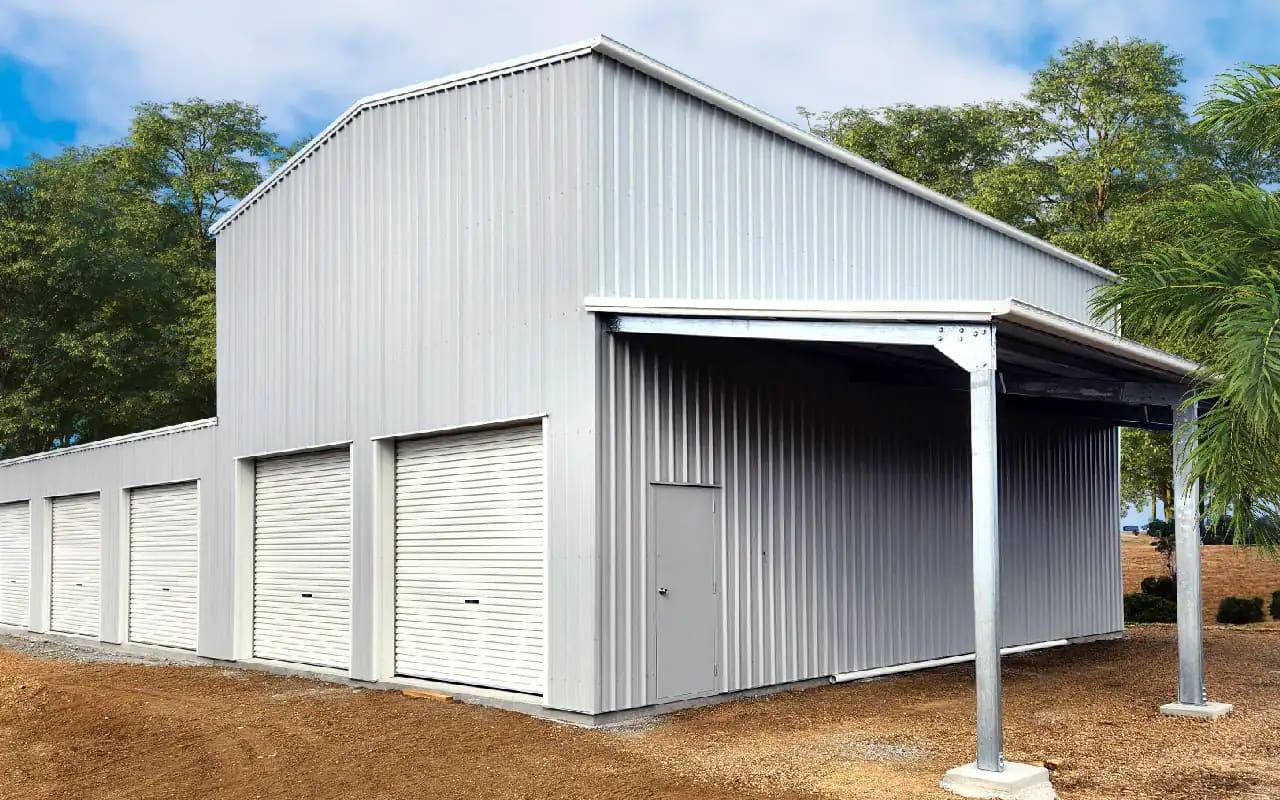
BlueScope describes ZINCALUME® steel as aluminium/zinc/magnesium alloy-coated steel strip (Type AM under AS 1397:2021). It has the bright metallic look you see on many farm sheds and older rural buildings. COLORBOND® steel starts from a metallic-coated steel substrate and adds a factory-applied paint system, available in Classic, Matt and Metallic finishes, with COLORBOND® Ultra steel for more severe environments.
For a shed, the choice is mostly about three things: how it looks next to the house and the landscape, where it is, and what goes on inside it.
Near the coast: BlueScope's distance guidance
Salt is the main external enemy of coated steel. BlueScope's roofing selection guide (TB-1A) gives these minimum distances from the high-water mark for roofing:
| Roofing product | From breaking surf or exposed marine | From calm marine |
|---|---|---|
| ZINCALUME® steel; COLORBOND® steel Metallic and Coolmax® | More than 200 m | More than 100 m |
| COLORBOND® steel, Classic or Matt finish | More than 200 m | More than 0 m |
| COLORBOND® Ultra steel | More than 100 m | More than 0 m |
| SUPERDURA® Stainless steel | More than 0 m | More than 0 m |
Walls get less rain-washing than roofs, so the walling guide (TB-1B) asks for greater distances. BlueScope's own simple guide for wall cladding is COLORBOND® steel beyond 800 m from breaking surf and COLORBOND® Ultra steel between 500 and 800 m. TB-35 defines the marine categories and lists Queensland examples: the Sunshine Coast and Gold Coast beaches are breaking surf, Moreton Bay and the Broadwater are exposed marine, and canal estates are calm marine.
Note:These are BlueScope's guides only. Actual performance depends on prevailing winds, sheltered areas that rain does not wash and other local conditions, and the tables apply to salt marine influence only.
Inland Queensland
Most of our sheds go up in the Lockyer Valley, on the Darling Downs and in the Brisbane hinterland, far from salt water. There, both products are normally suitable and the choice comes down to appearance, heat and budget. Many owners pick COLORBOND® steel in a colour that matches the house roof for a residential shed or garage, and ZINCALUME® steel for a farm shed.
What happens inside the shed matters too
BlueScope warns that some activities inside sheds and industrial buildings can make both COLORBOND® and ZINCALUME® steel unsuitable: heavy dust, emissions fallout, heat, moisture, corrosive chemicals and acids. It publishes separate bulletins for intensive animal farming and fertiliser storage, and notes that for intensive animal farming zinc-coated (galvanised) steel can be the preferred product. If the shed will house animals, fertiliser or chemicals, or a washdown area, tell us so the cladding can be chosen accordingly.
Condensation and insulation
Condensation forms when warm, moist air meets the underside of a roof sheet that has cooled overnight. BlueScope's condensation bulletin (CTB-11) recommends dealing with it at design stage, for example with a reflective membrane or blanket-and-foil insulation under the roof sheets, and ventilation. Insulation blankets should be kept clear of gutters and valleys, because a wet blanket held against the sheet can cause corrosion from underneath. Insulation also reduces the popping noise of roof sheets expanding in the sun.
Fasteners and flashings must match
BlueScope's fastener bulletin (TB-16) states that stainless steel, copper and copper alloys are incompatible with COLORBOND® and ZINCALUME® steel. So stainless screws are not the answer for a coastal shed clad in either product: use fasteners of the class BlueScope specifies for the environment.
Upkeep
Rain keeps exposed surfaces clean. BlueScope recommends hosing areas not washed by rain, such as wall cladding under eaves, garage doors and the underside of gutters, at least every six months and more often near the coast. Clean off metal swarf after any drilling or cutting, because it rusts quickly and stains the sheets. BlueScope does not recommend touch-up paint on COLORBOND® steel, because it weathers differently from the factory finish.
Warranties
BlueScope offers material warranties subject to application and eligibility. The warranty period depends on the end use and the location, and BlueScope's online estimator gives an indication for a given site. Owners can apply through BlueScope's Warranty Management System within 12 months of installation, or activate a pre-approved warranty provided by the builder. We will tell you what applies to your shed when we quote.
Sources
- BlueScope Technical Bulletin TB-1A – Steel roofing products selection guide
- BlueScope Technical Bulletin TB-1B – Steel walling products selection guide
- BlueScope Technical Bulletin TB-35 – Australian salt marine classifications
- BlueScope Technical Bulletin TB-16 – Fasteners for BlueScope coated steel products
- BlueScope Corrosion Technical Bulletin CTB-11 – Condensation and insulation
- COLORBOND® steel – Frequently asked questions (BlueScope)
- BlueScope Warranty Estimator