Design & sizing
Shed wind ratings in Queensland: regions, classes and what to check
By Lockyer Sheds, Crowley Vale QLD ·Getting started · 7 min read · Published
Short answer
A shed's wind rating is not a label from a brochure. The design wind speed is calculated for the actual site to AS/NZS 1170.2 (or AS 4055 for smaller buildings), from the wind region, terrain, shielding and topography, and the importance level of the building. Most of South East Queensland and the Darling Downs sits in non-cyclonic Region B1, while the coast from around Bundaberg north is cyclonic Region C.
Why wind decides so much of a shed's design
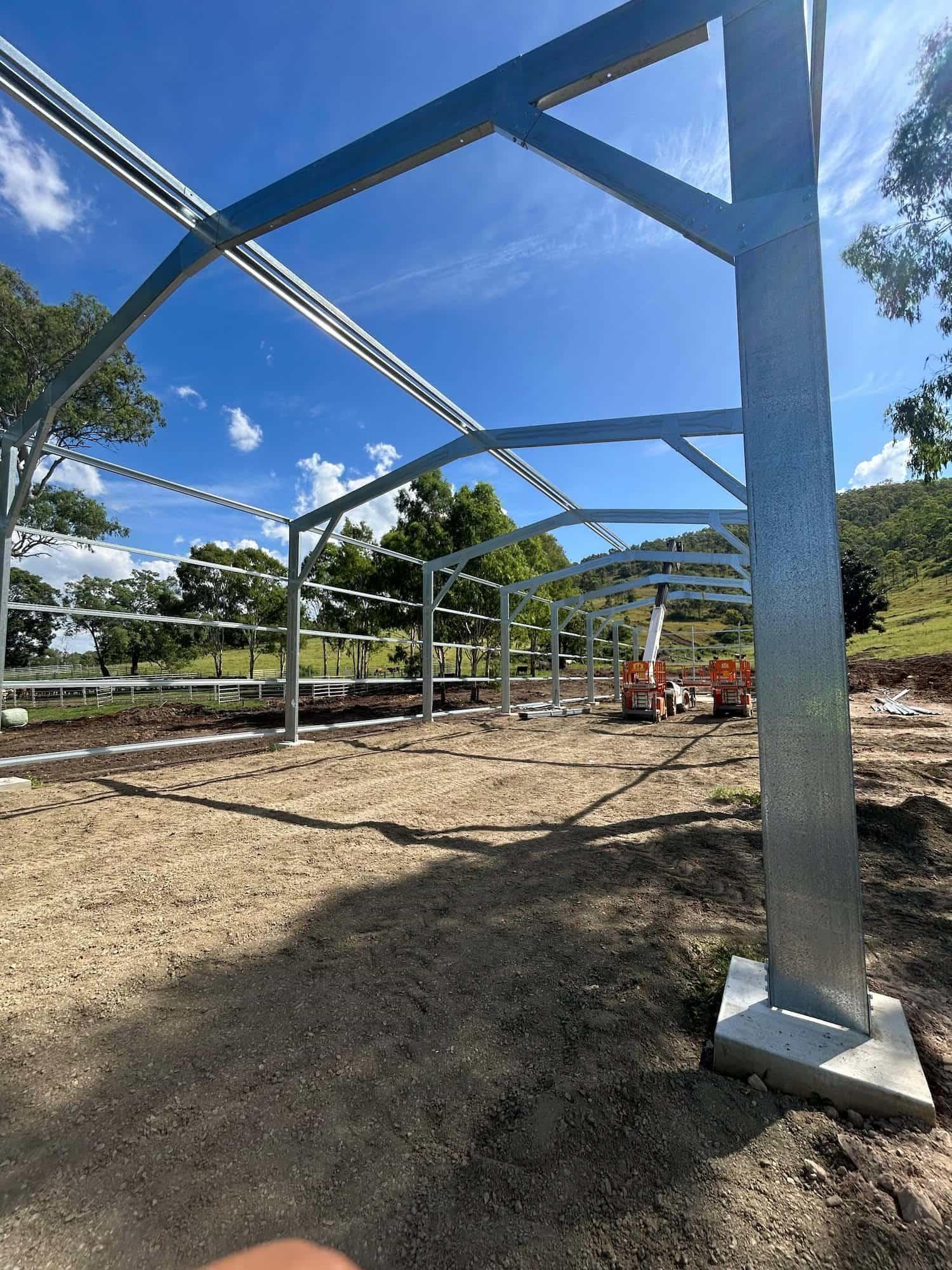
A steel shed is light and has large surfaces, often with big door openings. Wind, not the weight of the building, usually governs the size of the frames, the number of purlins and girts, the bracing, the fixings and the footings. That is why two sheds that look identical can have quite different engineering, and why a price for a shed rated for somewhere else is not a price for your site.
The standards
The NCC defines the design wind speed as the design gust wind speed for the site, calculated to AS/NZS 1170.2 or AS 4055. AS 4055 is a simplified method for smaller, house-like buildings within set limits; larger or unusual buildings, including many sheds, are designed to AS/NZS 1170.2 by an engineer. Wind classes follow from the calculation: N1 to N6 in non-cyclonic Regions A and B, and C1 to C4 in cyclonic Regions C and D.
The four things that set the wind load
| Input | What it means | Why it matters for a shed |
|---|---|---|
| Wind region | The broad zone on the map in AS/NZS 1170.2 (A, B, C, D) | Cyclonic regions need much stronger design |
| Terrain category | How rough the surrounding ground is: open paddock, scattered trees, suburbs | Open farmland gives little protection |
| Shielding | Buildings of similar height upwind | A rural shed usually has none |
| Topography | Hills, ridges and escarpments speed the wind up | Sites on the Range or a ridge line need care |
The engineer also assigns an importance level. The NCC describes Importance Level 1 as buildings presenting a low degree of hazard to life and other property if they fail, and the ABCB's guidance gives farm buildings and isolated minor storage as examples; houses and structures associated with them are Importance Level 2. Whether a particular shed can be treated as Importance Level 1 depends on what is around it, including neighbouring buildings and roads, so it is an engineering judgement, not a sales option.
Where Queensland's wind regions fall
Geoscience Australia publishes an indicative dataset of the AS/NZS 1170.2 wind regions. Testing towns against it places Brisbane, Ipswich, Toowoomba, Gatton, the Gold Coast, the Sunshine Coast, Dalby, Warwick, Beaudesert, Gympie and Hervey Bay in the non-cyclonic Region B1, and Bundaberg, Gladstone, Rockhampton, Mackay and Townsville in the cyclonic Region C. The dataset is not for design: the figure in the Standard prevails, and sites near a boundary are checked by the engineer.
Note:Being inside Region C also removes the small-shed exemption. Schedule 1 of the Building Regulation 2021 does not apply to building work within Wind Region C.
Rural sites on the Downs and the Range
Much of our work is on open farmland and on the Great Dividing Range around Toowoomba. Open terrain gives little shielding, and a site on a ridge or near the escarpment can be affected by topography. Neither is unusual; both are reasons the site address is the first thing we ask for.
What to check on a shed quote
- The quote or engineering names your site address, not just a region.
- The design wind speed or wind classification is stated, along with the terrain category and importance level the engineer used.
- The footing design is included and matches the building, because uplift from wind is resisted at the footings.
- Doors are included in the design: a large open door on the windward side changes the internal pressure.
- If you plan to leave a side open or add a carport later, the design already allows for it.
The Australian Steel Institute's ShedSafe program was set up after Cyclone Larry in 2006 to review shed suppliers' engineering for NCC compliance. It is worth knowing about when comparing quotes, even though accreditation alone does not replace checking that the design is for your site.
How we handle it
Every Lockyer Sheds design starts from the site address. The engineering for the building and its footings is prepared for that site and forms part of the approval documents. If your lot is close to a wind-region boundary or on exposed high ground, we will tell you before quoting.
Sources
- NCC 2022 Volume Two, Definitions (ABCB)
- NCC 2022 Housing Provisions, Part 2.2 Structural provisions (ABCB)
- NCC 2022 Volume One, Part B1 Structural provisions (ABCB)
- Geoscience Australia – AS/NZS 1170.2 wind regions for Australia (indicative dataset)
- Building Regulation 2021 (Qld), Schedules 1 and 2
- ShedSafe (Australian Steel Institute) – About